
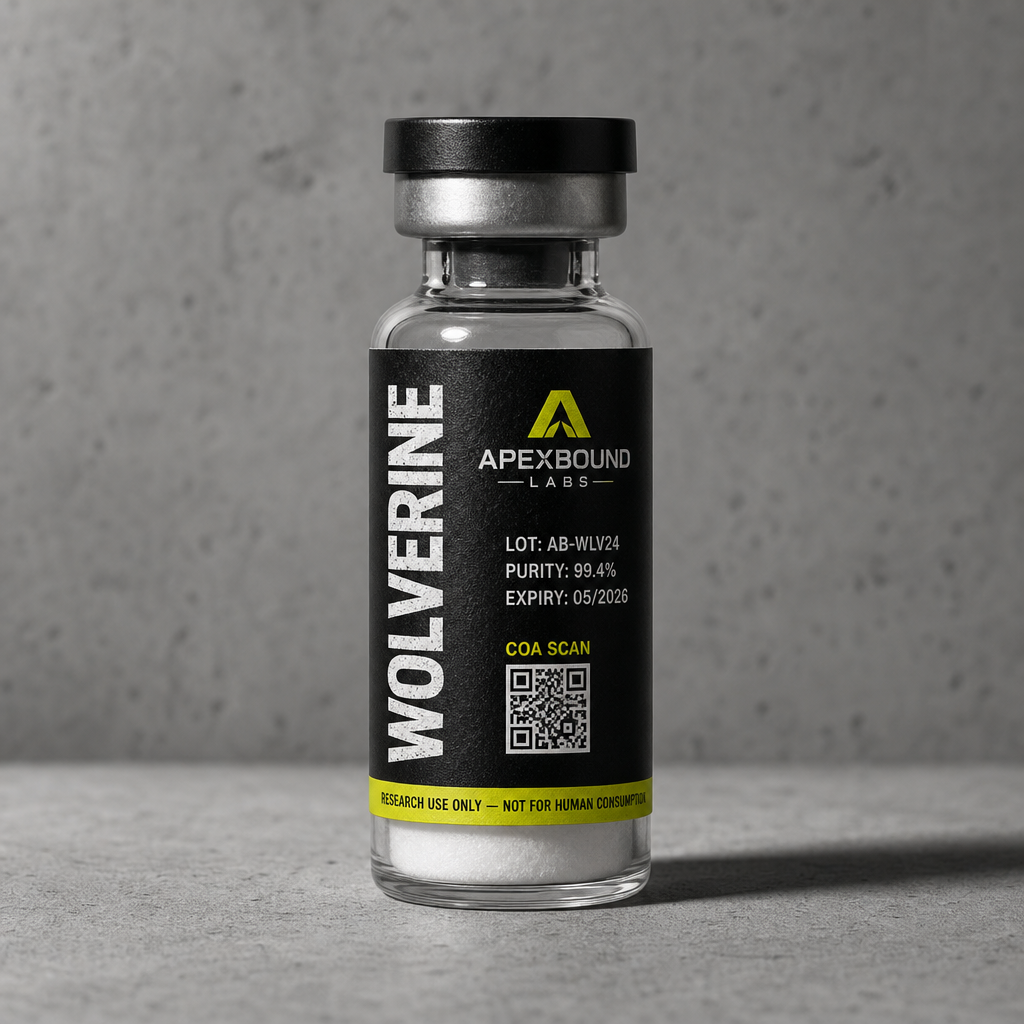
Wolverine Blend
BPC-157 / TB-500 recovery blend; "Wolverine Stack"
"Wolverine Blend" is an informal name for a combination of two synthetic research peptides studied in tissue-repair contexts: BPC-157, a stable gastric pentadecapeptide derived from a partial sequence of a body-protection compound found in gastric juice, and TB-500, a synthetic peptide based on the actin-binding region of thymosin beta-4. No published research examines the blend as a formulated product; the existing body of literature investigates each component independently, predominantly in vitro and in rodent models. BPC-157 research has examined connective-tissue repair endpoints, including tendon fibroblast outgrowth, survival, and migration, tendon-to-bone healing biomechanics, and growth hormone receptor expression. Thymosin beta-4 / TB-500 research has examined re-epithelialization and collagen deposition in cutaneous wound models, angiogenesis, and cardiac-cell migration and survival following experimental injury, with proposed involvement of actin regulation and integrin-linked kinase / Akt signaling. Across these studies, investigators describe associations between peptide administration and accelerated repair-related measures in animal and cell-culture systems. The literature is preclinical; human efficacy and safety have not been established, and these references are compiled for reference-library purposes only.
In preclinical models, BPC-157 has been associated with promotion of fibroblast outgrowth, migration, and survival (reported via FAK-paxillin signaling and upregulation of growth hormone receptor) during connective-tissue repair, while thymosin beta-4 / TB-500 has been studied as an actin-sequestering peptide linked to cell migration, angiogenesis, and survival signaling (e.g., integrin-linked kinase / Akt activation). Both are investigated for roles in wound and musculoskeletal tissue repair.
Note · "Wolverine Blend" is a combination product, not a single characterized molecule; no peer-reviewed studies exist on the blend itself. The references below research the two named component peptides separately: BPC-157 (a synthetic stable gastric pentadecapeptide) and TB-500 (a synthetic fragment corresponding to the actin-binding region of the endogenous protein thymosin beta-4). All four citations were located via web/PubMed search and individually verified on pubmed.ncbi.nlm.nih.gov. All findings are from in vitro and animal (rodent) model systems. Research-use-only context; no therapeutic or product claims.
In an in vitro / ex vivo study, BPC 157 was associated with accelerated outgrowth of tendon fibroblasts from tendon explants, increased cell survival under stress, and enhanced fibroblast migration, with the authors proposing involvement of the FAK-paxillin pathway.
In a rat Achilles tendon-to-bone detachment model, administration of BPC 157 was associated with improved functional, biomechanical, and histological healing measures and counteracted corticosteroid-related impairment of repair.
In a rodent full-thickness wound model, topical or intraperitoneal thymosin beta-4 (the parent peptide of TB-500) was associated with increased re-epithelialization and greater collagen deposition and angiogenesis in treated wounds relative to controls.
In cell-culture and mouse coronary-ligation models, thymosin beta-4 was reported to form a complex with PINCH and integrin-linked kinase, activate Akt, and was associated with enhanced early myocyte survival and improved cardiac functional measures after experimental injury.
Citations are provided for scientific reference and educational context only. They describe published laboratory and clinical research and do not constitute medical advice, dosing guidance, or any claim about an Apexbound Labs product. All products are sold strictly for in-vitro laboratory and research use.