
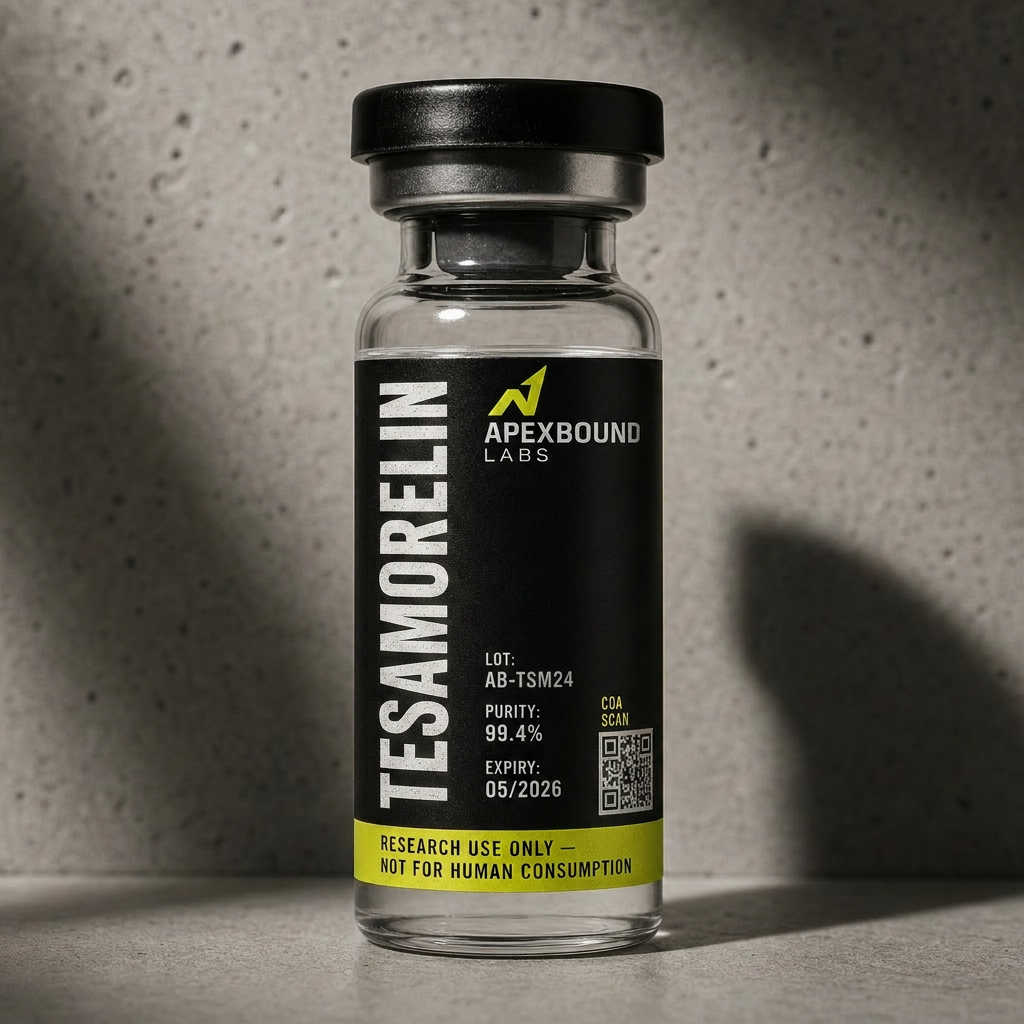
Tesamorelin
TH9507; trans-3-hexenoyl-GHRH(1-44) amide; stabilized growth hormone-releasing hormone (GHRH) analog
Tesamorelin is a synthetic, stabilized analog of human growth hormone-releasing hormone (GHRH, residues 1-44) bearing an N-terminal trans-3-hexenoyl modification that confers resistance to enzymatic degradation and extends half-life relative to native GHRH. As a research compound it has been studied as a hypothalamic-pituitary axis secretagogue: it binds pituitary GHRH receptors and stimulates endogenous, pulsatile growth hormone (GH) secretion, with downstream elevation of insulin-like growth factor-1 (IGF-1). The principal body of research has examined its effects on body composition and metabolism in the context of HIV-associated lipodystrophy and abdominal fat accumulation, where randomized placebo-controlled trials have characterized changes in visceral adipose tissue, trunk fat, lipid profiles (triglycerides, cholesterol ratios), hepatic fat content, and glucose homeostasis. Additional investigations have explored its metabolic effects in abdominally obese adults with relatively reduced GH secretion, and proteomic/transcriptomic studies have probed mechanistic pathways in HIV-associated fatty liver. Research domains span endocrinology, metabolism, body-composition imaging (CT/MRI-based fat quantification), and hepatic steatosis modeling. Studies have also monitored IGF-1 dynamics and glycemic safety signals as part of pharmacologic characterization.
Tesamorelin is a protease-resistant GHRH(1-44) analog that binds pituitary GHRH receptors to stimulate endogenous pulsatile growth hormone release, raising circulating IGF-1. In research models this GH/IGF-1 axis activation has been associated with reductions in visceral adipose tissue and shifts in lipid and hepatic-fat parameters.
Note · Single peptide (not a blend). Research is concentrated in HIV-associated lipodystrophy/abdominal fat accumulation models and abdominally obese cohorts with reduced GH secretion; findings below are framed as observations in clinical research, not therapeutic guidance.
In a randomized placebo-controlled trial of 412 HIV-infected adults with abdominal fat accumulation, daily subcutaneous tesamorelin over 26 weeks was associated with a measured reduction in visceral adipose tissue and changes in triglyceride and cholesterol ratios relative to placebo, with IGF-1 increases tracked as a pharmacodynamic marker.
This randomized placebo-controlled study with a safety-extension phase examined visceral adipose tissue change and tolerability parameters over extended dosing in HIV-infected adults with central fat accumulation, characterizing the durability of body-composition effects and monitoring glucose and IGF-1 measures.
In this randomized clinical trial, tesamorelin administration was investigated for its association with reductions in CT/MRI-quantified visceral fat and hepatic fat fraction in HIV-infected adults with abdominal fat accumulation, examining liver-fat outcomes as a primary endpoint.
In abdominally obese adults with relatively reduced growth hormone secretion, 12 months of tesamorelin versus placebo was studied for effects on visceral adipose tissue, triglycerides, C-reactive protein, and carotid intima-media thickness, extending mechanistic characterization beyond HIV cohorts.
Citations are provided for scientific reference and educational context only. They describe published laboratory and clinical research and do not constitute medical advice, dosing guidance, or any claim about an Apexbound Labs product. All products are sold strictly for in-vitro laboratory and research use.