
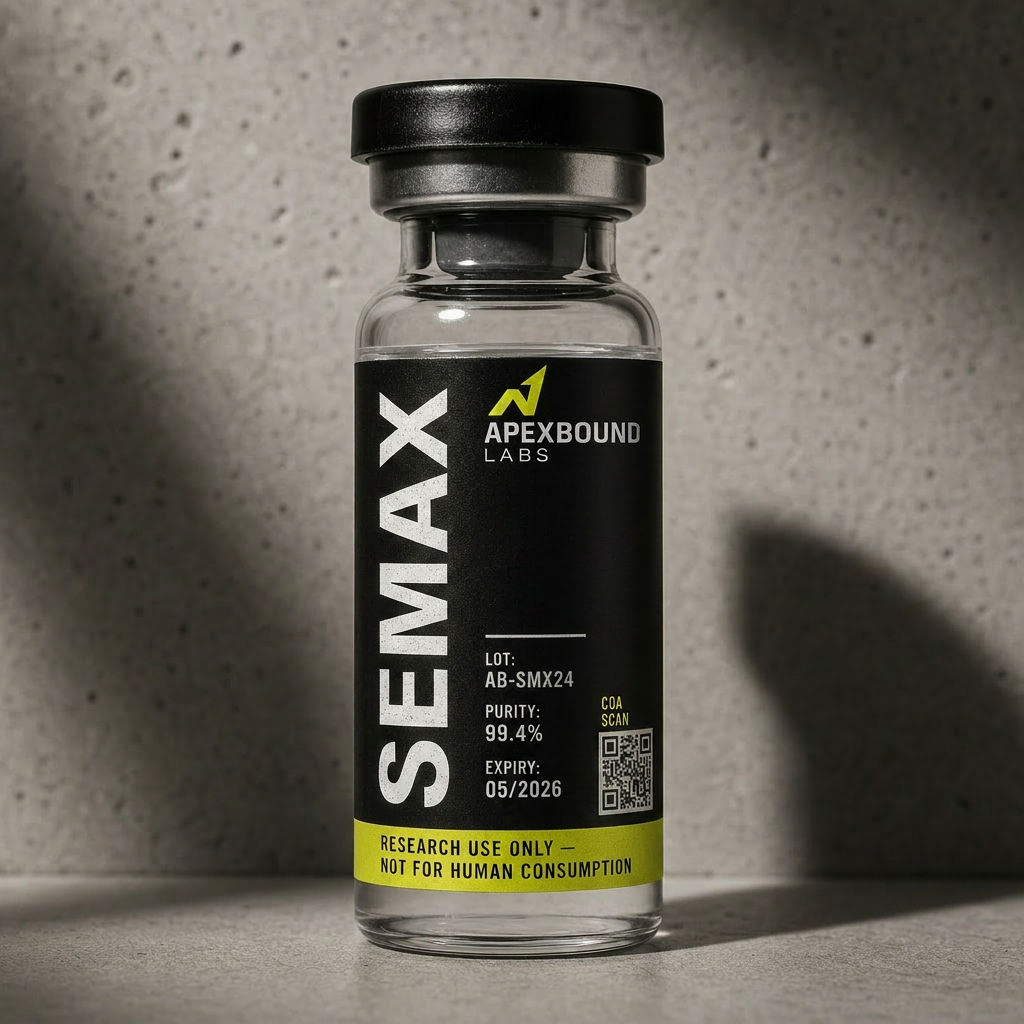
Semax
ACTH(4-10) analog; Met-Glu-His-Phe-Pro-Gly-Pro; MEHFPGP heptapeptide
Semax is a synthetic heptapeptide (Met-Glu-His-Phe-Pro-Gly-Pro) derived from the ACTH(4-10) fragment of adrenocorticotropic hormone, modified with a C-terminal Pro-Gly-Pro extension that confers metabolic stability while removing the parent hormone's classical hormonal activity. It has been studied extensively in Russian research programs as a candidate neuroactive and neuroprotective peptide. The published literature has examined Semax primarily in rodent models and in vitro systems, focusing on its effects on the brain-derived neurotrophic factor (BDNF)/TrkB signaling axis, nerve growth factor expression, dopaminergic and serotonergic neurotransmission, intracellular calcium dynamics, and transcriptional responses in cortical and hippocampal tissue. A substantial body of work has investigated Semax in experimental models of cerebral ischemia, where researchers have used genome-wide transcriptional profiling to characterize its modulation of genes linked to neurotrophin signaling, the immune system, and vascular function in ischemic rat brain. Reported observations include increases in hippocampal BDNF protein and trkB phosphorylation, changes in neurotrophin gene transcription after focal ischemia, and associations with conditioned-avoidance behavioral measures. The research domains span neurochemistry, behavioral neuroscience, and stroke models.
Research suggests Semax modulates the hippocampal and cortical BDNF/TrkB neurotrophin system, upregulating BDNF protein and trkB receptor phosphorylation, and that it influences neurotrophin gene transcription, immune/vascular-related gene expression, and monoaminergic signaling in rodent brain. The intact ACTH(4-7) core and the Pro-Gly-Pro tail have both been studied as contributors to its activity and proteolytic stability.
Note · Most of the primary literature derives from Russian research groups (Myasoedov, Dergunova, Dolotov and colleagues) using intranasal administration in rats; findings are from animal models and in vitro systems, not from this supplier's product. Pro-Gly-Pro, a component fragment, has been studied separately and compared against intact Semax in ischemia transcription studies.
In rats, a single intranasal administration of Semax was associated with increased hippocampal BDNF protein levels and trkB tyrosine phosphorylation, along with elevated BDNF and trkB mRNA, which the authors related to changes in a conditioned-avoidance learning measure.
Using genome-wide transcriptional profiling at 3 and 24 hours after focal ischemia in rats, the study observed that Semax predominantly altered expression of genes associated with the immune system and vascular function in ischemic brain tissue.
In a rat model of cerebral ischemia, Semax was observed to selectively affect transcription of neurotrophins and their receptors in the ischemic cortex during the early post-ischemic period, whereas the Pro-Gly-Pro fragment showed mainly non-specific effects.
This study reported specific binding of Semax in rat basal forebrain tissue and examined associated increases in BDNF protein levels, characterizing a possible molecular target relevant to the peptide's neurotrophic effects in rodent brain.
Citations are provided for scientific reference and educational context only. They describe published laboratory and clinical research and do not constitute medical advice, dosing guidance, or any claim about an Apexbound Labs product. All products are sold strictly for in-vitro laboratory and research use.