
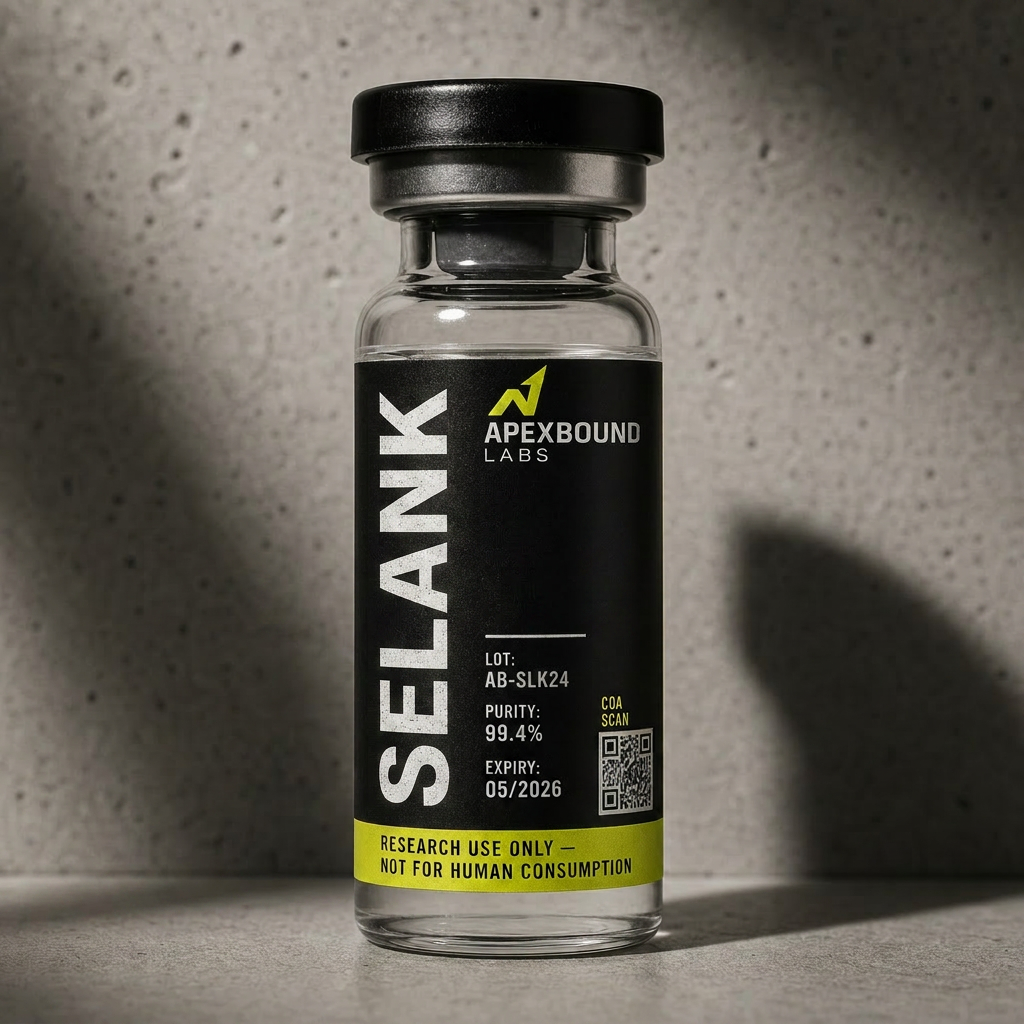
Selank
Selank; TP-7; threonyl-lysyl-prolyl-arginyl-prolyl-glycyl-proline; synthetic tuftsin analog
Selank (Thr-Lys-Pro-Arg-Pro-Gly-Pro) is a synthetic heptapeptide developed at the Institute of Molecular Genetics of the Russian Academy of Sciences as a metabolically stabilized analog of the endogenous immunomodulatory tetrapeptide tuftsin (Thr-Lys-Pro-Arg), with two C-terminal residues (Pro-Gly-Pro) added to extend its half-life. It has been studied primarily in rodent models and cell systems as a candidate anxiolytic and neurotropic agent that, unlike benzodiazepines, has not been associated in these studies with sedation, motor impairment, or dependence-like signs. The research literature has examined several mechanistic axes: modulation of the expression of GABAergic-neurotransmission genes in rat frontal cortex and in neuronal cell lines, regulation of brain-derived neurotrophic factor (BDNF) mRNA and protein in the hippocampus after intranasal delivery, strain-dependent shifts in brain monoamine (norepinephrine, dopamine, serotonin) content and turnover, and attenuation of behavioral signs of morphine withdrawal. Research domains span anxiety-related behavior, learning and memory, neuroplasticity, monoaminergic and GABAergic signaling, and neuroimmune interactions. Findings to date derive largely from preclinical animal and in vitro work plus limited Russian-language clinical literature.
Research suggests Selank acts as a regulatory peptide that influences expression of genes governing GABAergic neurotransmission and upregulates hippocampal BDNF, while also modulating brain monoamine levels and turnover. Its effects have been proposed to resemble allosteric modulation of GABAergic signaling without the typical benzodiazepine side-effect profile in animal models.
Note · Single-compound heptapeptide (not a blend). Studied as a synthetic analog of the endogenous peptide tuftsin. Much of the body of work is preclinical (rodent and cell-culture) from Russian research groups.
In rats, a single administration of Selank was associated with significant changes in the expression of numerous genes related to GABAergic neurotransmission in the frontal cortex within one hour, leading the authors to hypothesize an interaction with GABAergic signaling distinct from classical benzodiazepines.
In rats, intranasal Selank was reported to increase hippocampal Bdnf mRNA a few hours after injection and BDNF protein at 24 hours, indicating modulation of a neurotrophic factor implicated in synaptic plasticity.
In a naloxone-precipitated morphine withdrawal model in rats, a single intraperitoneal dose of Selank was associated with a reduction in the total withdrawal index and attenuation of certain aversive behavioral signs, with effects compared against diazepam.
In a comparative study of two mouse strains, Selank was associated with strain-dependent changes in brain monoamine content and metabolite levels, including altered norepinephrine in the hypothalamus, suggesting strain-related differences in monoaminergic responses.
Citations are provided for scientific reference and educational context only. They describe published laboratory and clinical research and do not constitute medical advice, dosing guidance, or any claim about an Apexbound Labs product. All products are sold strictly for in-vitro laboratory and research use.