
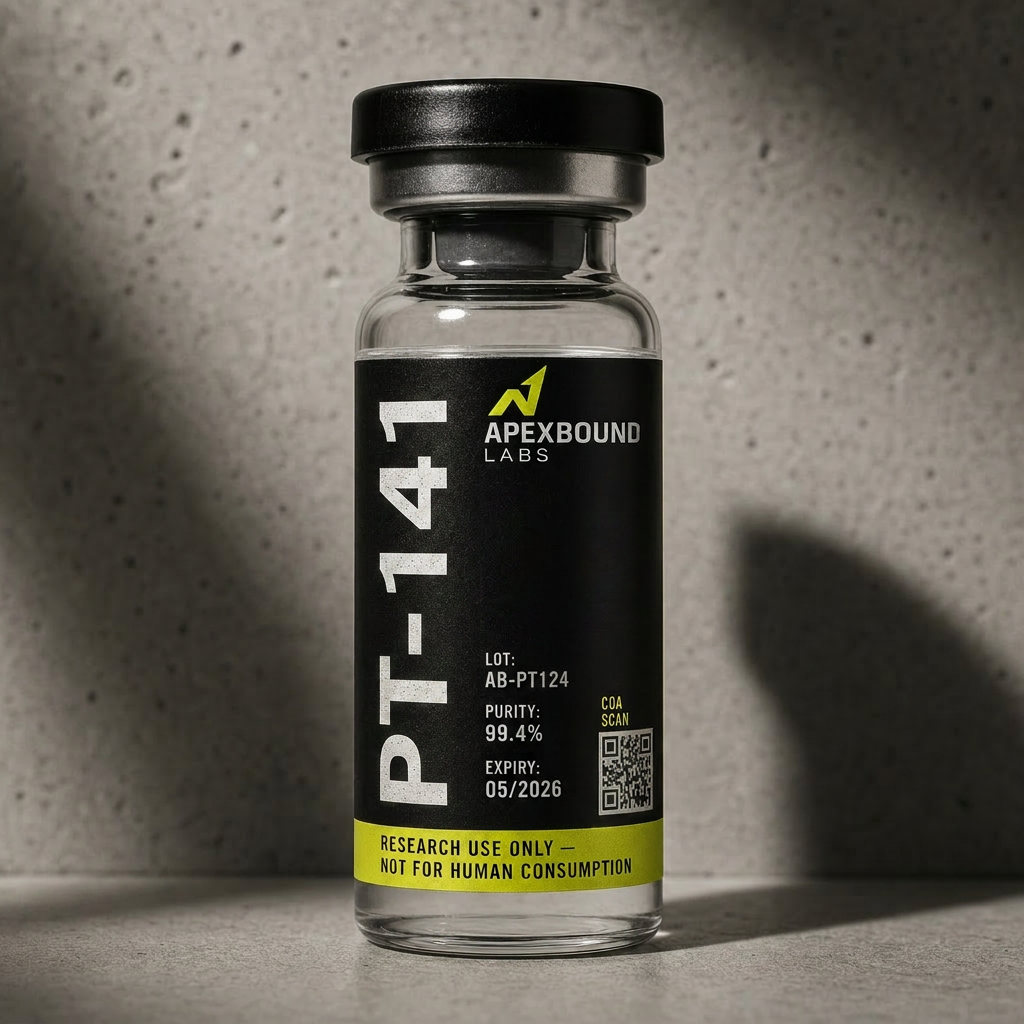
PT-141
Bremelanotide; PT-141; melanocortin receptor agonist; cyclic analog of alpha-MSH (Ac-Nle-cyclo[Asp-His-D-Phe-Arg-Trp-Lys]-OH)
PT-141 (bremelanotide) is a synthetic cyclic heptapeptide analog of alpha-melanocyte-stimulating hormone (alpha-MSH) that acts as a non-selective agonist at central melanocortin receptors, with research interest focused on the MC3R and MC4R subtypes expressed in the central nervous system. Unlike vasoactive agents that act on peripheral vascular tissue, the compound has been investigated as a centrally-acting probe of melanocortin signaling. Preclinical research in rodent models has examined its activation of hypothalamic and limbic regions, including the medial preoptic area, in relation to appetitive and proceptive sexual behaviors. Pharmacology and pharmacokinetic studies in early human research characterized intranasal and subcutaneous administration and dose-response of erectile activity, while ambulatory blood pressure monitoring has been used to characterize its cardiovascular pharmacodynamic profile. Later randomized controlled research evaluated subcutaneous bremelanotide against placebo in premenopausal women. More recent in vitro work has explored melanocortin-pathway effects in glioblastoma cell lines. The body of literature spans receptor pharmacology, CNS circuitry, pharmacokinetics, cardiovascular signaling, and exploratory oncology models.
Bremelanotide is a cyclic alpha-MSH peptide analog that acts as an agonist at melanocortin receptors, principally MC3R and MC4R in the central nervous system. In animal models, MC4R activation in hypothalamic and limbic regions (e.g., the medial preoptic area) has been associated with modulation of neural circuits governing appetitive behaviors, rather than acting directly on peripheral vascular tissue.
Note · Single-compound peptide (not a blend). All four citations verified via NCBI E-utilities (esummary) for title, first author, journal, and year; PMIDs confirmed. Findings are framed strictly around what was studied/observed in the cited model systems (rodent, healthy-volunteer/clinical pharmacology, randomized trial, and glioblastoma cell line).
This review summarized preclinical rodent research in which peripheral administration or direct central infusion of bremelanotide was associated with activation of hypothalamic and limbic regions, including the medial preoptic area, and with increased appetitive (solicitation) behaviors, supporting a centrally-mediated melanocortin mechanism.
This early pharmacology paper characterized PT-141 as a synthetic melanocortin-receptor agonist and reported that, in animal models and in human pharmacology studies, administration was associated with a dose-dependent increase in erectile activity, framing the compound as a centrally-acting melanocortin probe.
These two randomized, double-blind, placebo-controlled Phase 3 trials evaluated subcutaneously self-administered bremelanotide versus placebo in premenopausal women, measuring changes in standardized desire and distress outcome scales over the study period.
In this in vitro study, exposure of glioblastoma cell lines to bremelanotide was associated with reduced survivin expression, growth inhibition, and induction of cell death at concentrations reported as not toxic to normal human cells, exploring a melanocortin-pathway mechanism in a cancer cell model.
Citations are provided for scientific reference and educational context only. They describe published laboratory and clinical research and do not constitute medical advice, dosing guidance, or any claim about an Apexbound Labs product. All products are sold strictly for in-vitro laboratory and research use.