
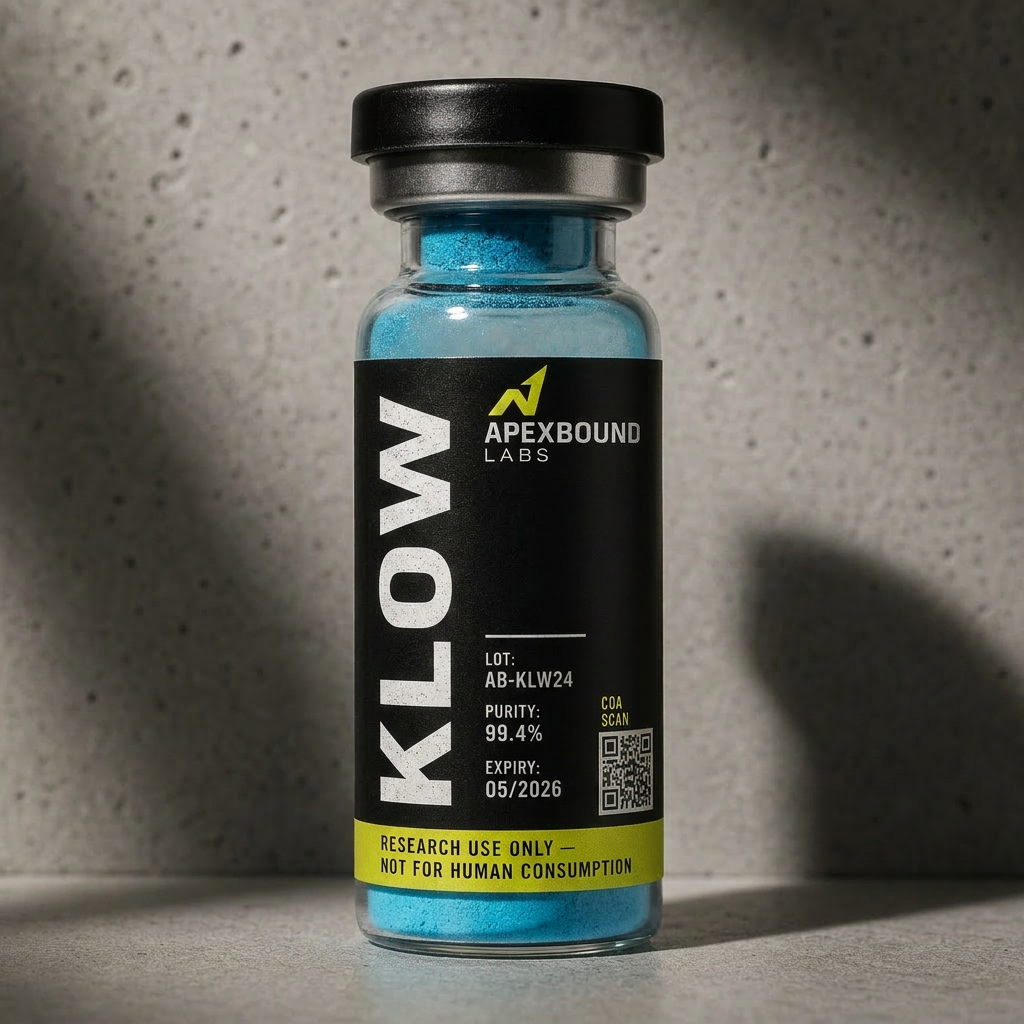
KLOW
KLOW multi-peptide blend (GHK-Cu + KPV + BPC-157 + TB-500)
The "KLOW blend" is a research-use combination marketed as containing four separately studied peptides: GHK-Cu, KPV, BPC-157, and TB-500. There is no peer-reviewed literature on the combined formulation; the body of research instead addresses each component individually, almost entirely in vitro and in animal models. GHK-Cu, a copper-binding tripeptide, has been investigated for its association with collagen and glycosaminoglycan turnover, matrix-metalloproteinase regulation, and angiogenic gene expression in skin and fibroblast systems. KPV, derived from the C-terminal tripeptide of alpha-MSH, has been examined in rodent colitis models where its uptake via the PepT1 transporter was associated with reduced NF-kB/MAPK-driven inflammatory signaling. BPC-157, a synthetic gastric pentadecapeptide, has been studied in rat tendon and musculotendinous-injury models for effects on fibroblast outgrowth, survival, migration, and growth-hormone-receptor expression. TB-500 corresponds to an active region of thymosin beta-4, which has been investigated in murine wound-healing and ischemia models for re-epithelialization, cell migration, and VEGF-related angiogenesis. The references below document these component-level preclinical findings; they do not establish outcomes for the combined blend.
The component peptides have each been studied for distinct tissue-repair and inflammation-related pathways in laboratory models: GHK-Cu for copper-dependent modulation of collagen/ECM remodeling and angiogenic gene expression; KPV for PepT1-mediated entry into epithelial/immune cells and downregulation of NF-kB/MAPK inflammatory signaling; BPC-157 for upregulation of growth-factor receptor expression and pro-survival, pro-migratory signaling (e.g., FAK-paxillin) in fibroblasts; and TB-500/thymosin beta-4 for G-actin sequestration, cell migration, and VEGF-associated angiogenesis. No combined-blend mechanism has been characterized in the literature.
Note · "KLOW" is not a single molecule but a research-supplier blend whose name is commonly an acronym for its four component peptides. Because no peer-reviewed literature exists on the combined "KLOW" formulation itself, the references below were gathered for the individual named components: GHK-Cu (copper tripeptide glycyl-L-histidyl-L-lysine), KPV (the alpha-MSH(11-13) tripeptide Lys-Pro-Val), BPC-157 (a stable gastric pentadecapeptide), and TB-500 (a synthetic fragment region of thymosin beta-4). Each study below corresponds to one component and reflects preclinical (in vitro / animal-model) research only.
In cultured rat Achilles tendon fibroblasts, BPC 157 was associated with accelerated ex vivo outgrowth from tendon explants, increased cell survival under stress, and enhanced fibroblast migration, with the authors linking the migratory effect to activation of the FAK-paxillin pathway.
This review summarizes in vitro and animal research in which the copper tripeptide GHK-Cu was associated with modulation of collagen and glycosaminoglycan turnover, regulation of matrix metalloproteinases and their inhibitors, and changes in genes related to skin remodeling and angiogenesis.
In murine DSS-colitis and CD45RBhi transfer-colitis models, the alpha-MSH-derived tripeptide KPV was associated with reduced colonic inflammatory infiltrates and lower myeloperoxidase activity, an effect the authors reported as at least partly independent of melanocortin-receptor signaling.
In a rat full-thickness wound model, topical or intraperitoneal thymosin beta-4 (the parent molecule of the TB-500 fragment) was associated with increased re-epithelialization at 4 and 7 days post-wounding alongside greater collagen deposition and angiogenesis in treated wounds.
Citations are provided for scientific reference and educational context only. They describe published laboratory and clinical research and do not constitute medical advice, dosing guidance, or any claim about an Apexbound Labs product. All products are sold strictly for in-vitro laboratory and research use.