
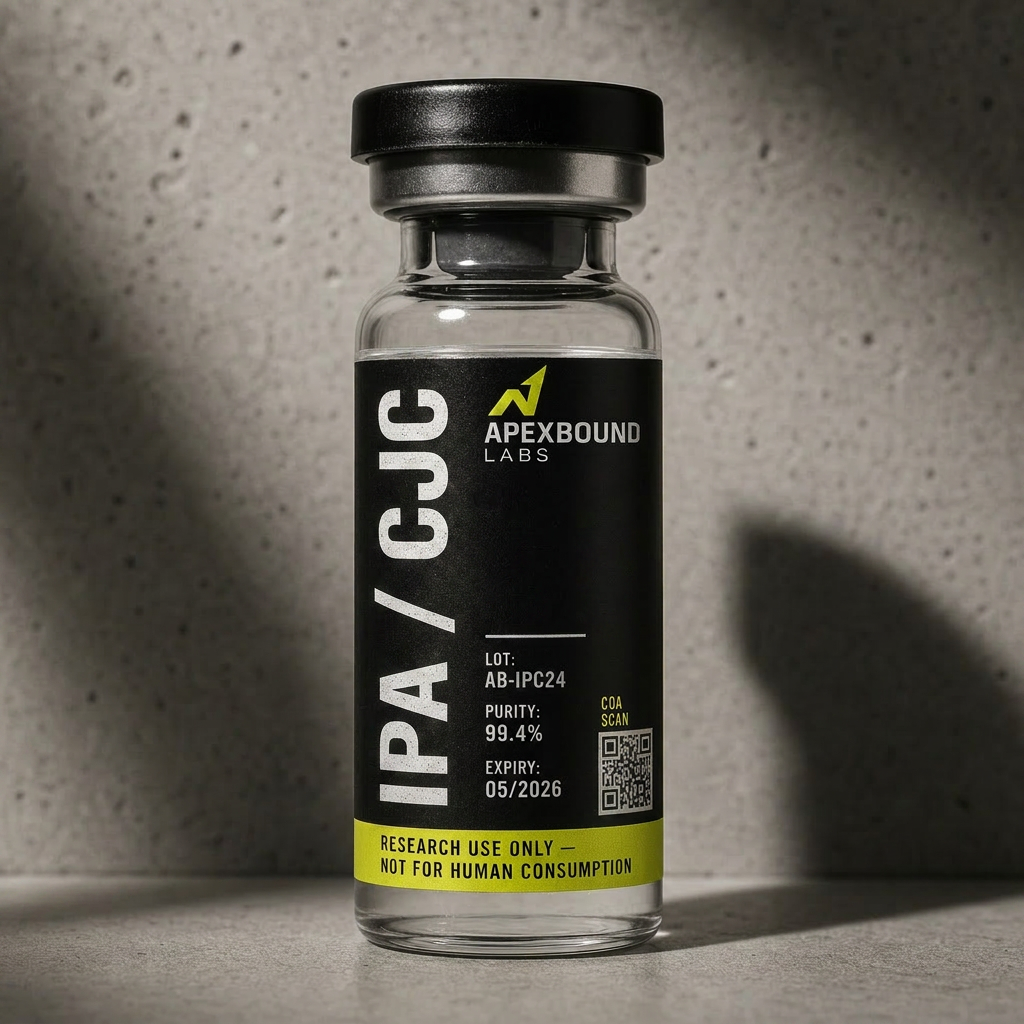
IPA / CJC No DAC
Ipamorelin (NNC 26-0161) + Modified GRF (1-29) / CJC-1295 without DAC; growth hormone secretagogue (GHS) blend
Ipamorelin and "CJC-1295 (no DAC)" (Modified GRF 1-29) are two synthetic growth-hormone secretagogues investigated in laboratory and animal models for their ability to stimulate endogenous growth-hormone (GH) secretion through complementary receptor systems. Ipamorelin is a pentapeptide first characterized by Raun and colleagues (1998) as the first selective GHS-R1a (ghrelin-receptor) agonist, which in rat pituitary cells and in vivo models released GH with potency similar to GHRP-6 but, notably, without significantly elevating ACTH or cortisol. Subsequent rodent work examined its effects on somatotroph-cell populations and intracellular GH content during chronic administration. The "CJC-1295" component derives from work by Jette and colleagues (2005), who synthesized hGRF(1-29)-albumin bioconjugates that activate the GRF (GHRH) receptor on the anterior pituitary in rats with enhanced stability against dipeptidyl-peptidase-IV. The drug-affinity-complex (DAC) form was later studied in healthy adults by Teichman and colleagues (2006) for prolonged GH/IGF-I stimulation. Research domains include receptor pharmacology, pituitary somatotroph physiology, GH/IGF-I pharmacodynamics, and analytical detection methods. These are research-use reference compounds; the body of literature is mechanistic and preclinical, with limited early human pharmacokinetic data on the DAC-conjugated analog.
Ipamorelin selectively activates the ghrelin/GHS-R1a receptor on pituitary somatotrophs to stimulate pulsatile growth-hormone release, while CJC-1295/Modified GRF (1-29) is a GHRH (GRF) receptor analog that activates the complementary GHRH pathway; the two have been studied as mechanistically distinct secretagogues acting on parallel arms of GH regulation.
Note · This is a research blend of two distinct peptides, so the cited literature characterizes each component separately. Ipamorelin is a selective ghrelin-receptor (GHS-R1a) agonist studied as a synthetic growth-hormone secretagogue. "CJC-1295 (no DAC)" refers to Modified GRF (1-29), the un-conjugated tetra-substituted hGRF(1-29) GHRH/GRF-receptor analog; the seminal Jette 2005 paper characterizes the GRF(1-29)-albumin bioconjugate platform from which it derives. Important distinction: the Teichman 2006 human pharmacokinetic trial studied CJC-1295 WITH DAC (the long-acting drug-affinity-complex form), not the "no DAC" version named in this product; it is included as the closest characterized analog. No published clinical study of the specific Ipamorelin + Modified GRF (1-29) combination in humans was located.
In rat pituitary cells and in vivo rat and swine models, ipamorelin was characterized as a selective GHS-R agonist that released GH with potency similar to GHRP-6 but, unlike other secretagogues tested, did not significantly raise ACTH or cortisol above GHRH-stimulated levels.
In young female rats, chronic ipamorelin administration was investigated for its effect on the somatotroph cell population and on intracellular GH content in cultured pituitary cells, with observed increases in intracellular GH content.
Maleimido derivatives of hGRF(1-29) conjugated to albumin showed enhanced in vitro stability against dipeptidyl-peptidase-IV and activated the GRF receptor in cultured rat anterior pituitary cells; CJC-1295 produced an approximately 4-fold increase in GH area-under-the-curve over 2 h versus hGRF(1-29) and persisted in circulation beyond 72 h.
In two placebo-controlled ascending-dose studies in healthy adults, a single subcutaneous injection of CJC-1295 (DAC form) was associated with dose-dependent increases in mean plasma GH (2- to 10-fold) and IGF-I (1.5- to 3-fold) lasting several days, with an estimated half-life of roughly 6-8 days.
Citations are provided for scientific reference and educational context only. They describe published laboratory and clinical research and do not constitute medical advice, dosing guidance, or any claim about an Apexbound Labs product. All products are sold strictly for in-vitro laboratory and research use.