
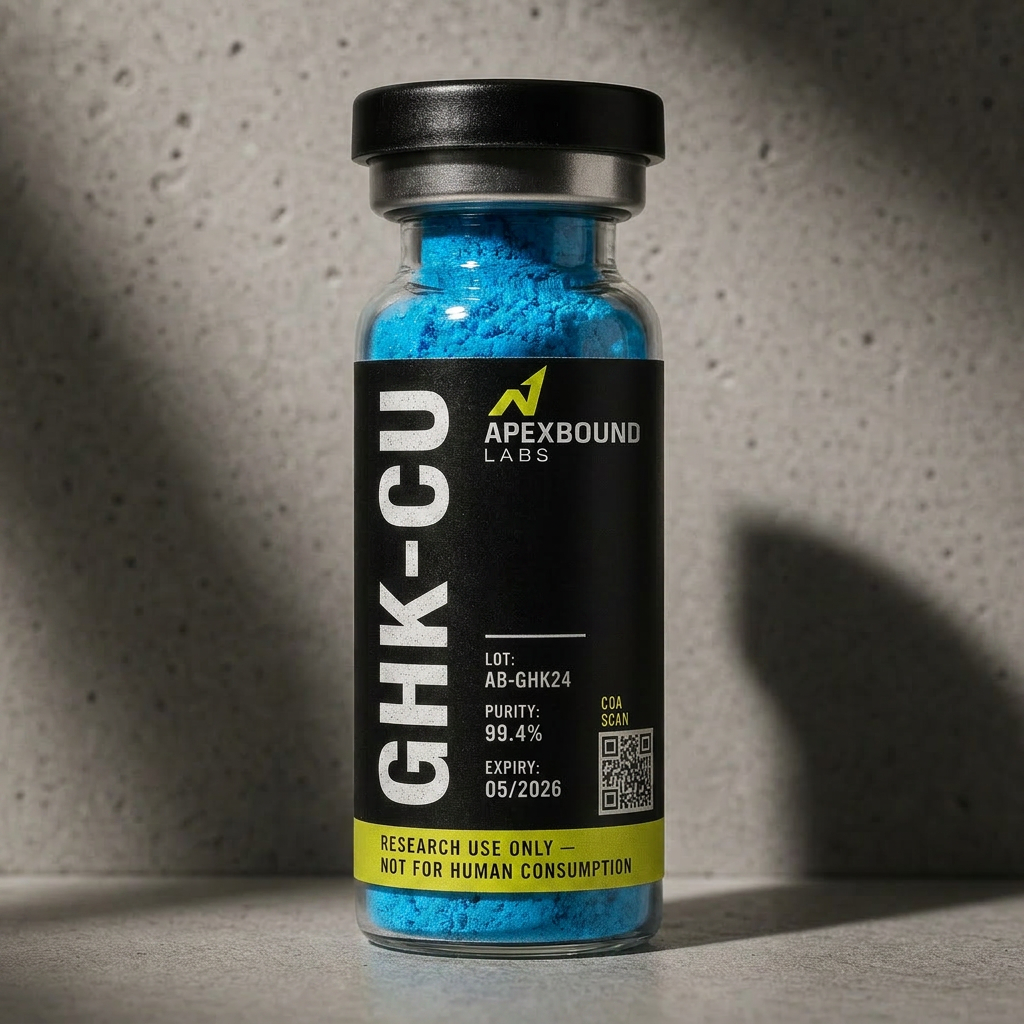
GHK-Cu
Copper tripeptide-1; GHK-Cu complex; glycyl-L-histidyl-L-lysine:copper(II); Cu-GHK
GHK-Cu is the copper(II) complex of the naturally occurring human tripeptide glycyl-L-histidyl-L-lysine (GHK), first isolated from human plasma in the 1970s. GHK has high affinity for copper(II) ions, and the resulting GHK-Cu complex is the form studied in most biological models. Reported plasma GHK levels decline with age, which has prompted research interest in its regenerative-associated activities. The body of research has examined GHK-Cu primarily in in vitro cell culture and rodent models, with domains including extracellular-matrix remodeling, fibroblast collagen and glycosaminoglycan synthesis, angiogenesis, antioxidant and anti-inflammatory signaling, and broad transcriptomic modulation. Gene-expression analyses using public perturbation datasets have reported that GHK can up- and down-regulate large numbers of human genes, including genes relevant to tissue repair, DNA repair, and nervous-system function. Controlled animal and clinical wound-healing studies have produced mixed results, with some irradiated-wound and laser-resurfacing models reporting no significant difference from controls. Research framing across this literature remains preclinical and mechanistic, characterizing observed cellular and molecular effects rather than establishing clinical outcomes in humans.
GHK chelates copper(II) to form GHK-Cu, a form associated in cell and animal models with modulation of fibroblast collagen and glycosaminoglycan synthesis, metalloproteinase regulation, and angiogenic and antioxidant signaling. Transcriptomic analyses report broad up- and down-regulation of human genes consistent with extracellular-matrix remodeling and tissue-repair pathways.
Note · GHK-Cu is a single defined copper-peptide complex (not a blend); the studies below examine the GHK tripeptide and its copper(II) complex directly. Wound-healing evidence is mixed: controlled animal/clinical models (e.g., irradiated rat flaps) reported no significant difference from controls, while review and gene-data papers describe broad mechanistic activity. Several high-citation papers are authored by L. Pickart, a researcher historically associated with GHK-Cu, which is relevant context for interpreting the literature.
This review summarized in vitro and animal-model evidence that the GHK tripeptide and its copper complex have been investigated for effects on collagen and glycosaminoglycan synthesis, antioxidant and anti-inflammatory signaling, and stem-cell-related pathways relevant to dermal repair.
Using public gene-perturbation datasets, this analysis reported that GHK can up- and down-regulate large numbers of human genes, examining transcriptomic patterns the authors associated with tissue remodeling, DNA repair, and antioxidant responses in cell-based data.
This review examined reported antioxidant and anti-inflammatory activities of GHK-Cu in experimental systems, discussing in vitro and animal data on copper-binding, gene-expression effects, and oxidative-stress-related pathways.
In a controlled irradiated-rat-flap model, topical GHK-Cu gel was associated with no significant difference in flap ischemia, blood-vessel number or area, or VEGF expression compared with controls, illustrating mixed outcomes in wound-healing animal studies.
Citations are provided for scientific reference and educational context only. They describe published laboratory and clinical research and do not constitute medical advice, dosing guidance, or any claim about an Apexbound Labs product. All products are sold strictly for in-vitro laboratory and research use.