
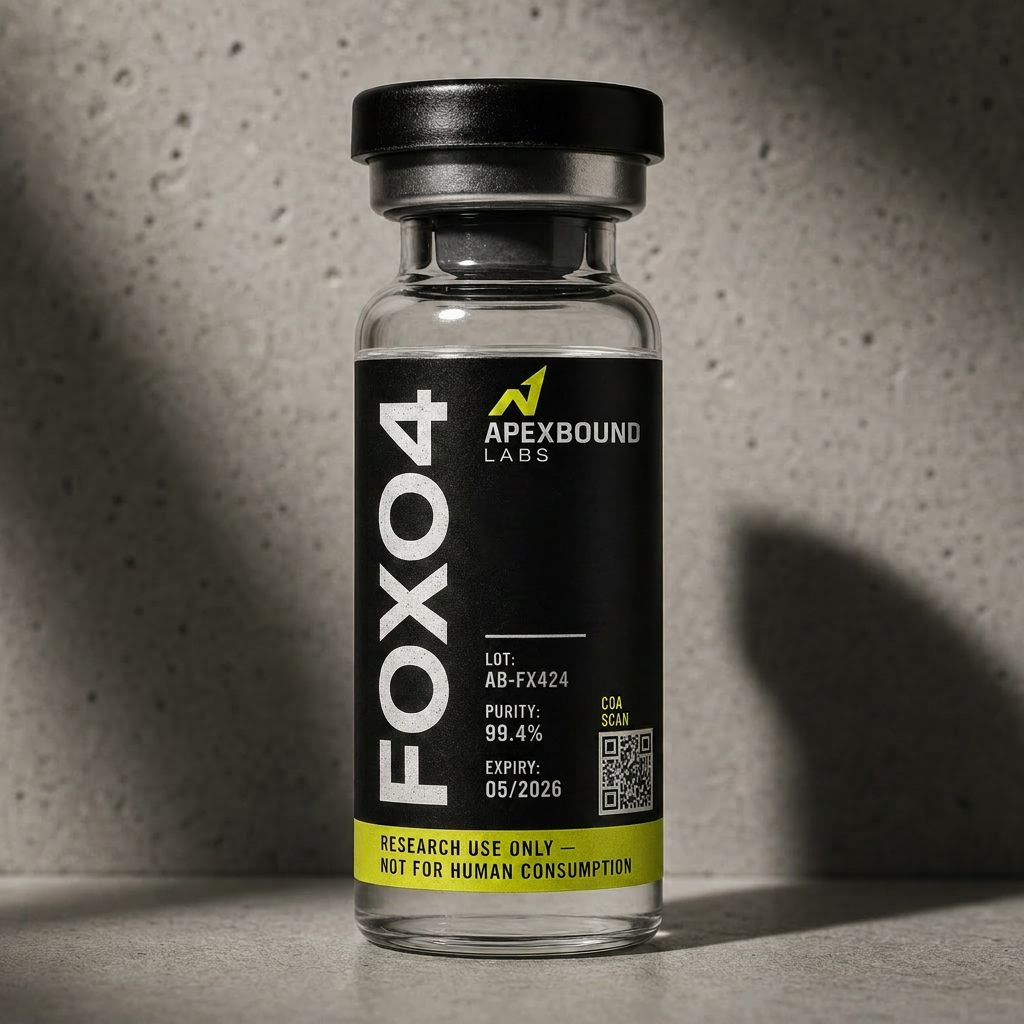
FOXO4
FOXO4-DRI, FOXO4 D-Retro-Inverso peptide, FOXO4-p53 disrupting peptide, proxofim
FOXO4-DRI is a synthetic D-retro-inverso peptide (a protease-resistant peptide built from D-amino acids in reverse sequence) studied as a senolytic research compound. It is derived from the forkhead box O4 (FOXO4) protein and was engineered to interfere with the FOXO4-p53 protein-protein interaction. In research model systems, senescent ("zombie") cells show elevated FOXO4, which is reported to sequester p53 in the nucleus and help maintain the viability of these cells. The body of published research has examined whether disrupting this interaction selectively triggers apoptosis in senescent cells while largely sparing proliferating cells. Studies span in vitro work (human chondrocytes, endothelial cells), structural biophysics of how the peptide engages the intrinsically disordered p53 transactivation domain, and rodent models (naturally aged mice, fast-aging XpdTTD/TTD mice, aged Leydig cells). Research domains include cellular senescence, aging biology, tissue homeostasis after chemotoxicity, vascular aging, and reproductive aging. All findings to date are preclinical (cell culture and animal models) and structural; FOXO4-DRI is described in the literature as an investigational research compound, not an approved therapeutic.
FOXO4-DRI is designed to competitively disrupt the FOXO4-p53 interaction, releasing p53 from nuclear sequestration so that p53 is excluded from the nucleus and directed toward mitochondria. In senescent cells this has been associated with intrinsic apoptosis via BAX activation and caspase-3 cleavage.
Note · Single-peptide research compound (not a blend). The foundational reference (Baar et al. 2017, Cell) is the paper that introduced the FOXO4-DRI peptide; later citations characterize its structural target and test it in additional cell and rodent senescence models. All cited studies were located and verified via PubMed search; PMIDs and DOIs confirmed against PubMed records.
This foundational study designed the FOXO4 peptide (FOXO4-DRI) to perturb the FOXO4-p53 interaction, reporting that in senescent cells it caused p53 nuclear exclusion and cell-intrinsic apoptosis, and that in naturally aged and fast-aging mouse models it was associated with restored fitness, fur density, and renal function and reduced doxorubicin-induced chemotoxicity.
Using biophysical and structural approaches, this study characterized how the disordered FOXO4-DRI peptide engages the intrinsically disordered p53 transactivation domain (p53TAD2), forming a transiently folded complex, providing a structural basis for how the senolytic compound interacts with p53.
In aged mouse models, this study examined FOXO4-DRI as a means to selectively eliminate senescent Leydig cells and reported associated effects on testosterone secretion, framed as a model of reproductive/endocrine aging.
This study investigated FOXO4-DRI in the context of endothelial cell senescence and vascular aging, examining the P53 signaling pathway as the mechanism by which the peptide is associated with selective elimination of senescent endothelial cells in cell and animal models.
Citations are provided for scientific reference and educational context only. They describe published laboratory and clinical research and do not constitute medical advice, dosing guidance, or any claim about an Apexbound Labs product. All products are sold strictly for in-vitro laboratory and research use.